
/icons/CubeCOS%20logomark%20bg.svg)

/icons/CubeVDI%20logomark.svg)
/logos/CubeDPX%20logomark.svg)
/icons/Data%20Protection-1.svg)
/icons/VMware%20Alternative.svg)
/icons/Application.svg)
/icons/case-study.svg)

/icons/News.svg)
/icons/Blog.svg)

/icons/Security%20Advisories.svg)
/icons/Document.svg)
/logos/slack%20logo.svg)
/logos/github.png)
/Events%20and%20News/CubeCMP-2.1-Release.jpg)
CubeCMP 2.1, adds native network function virtualization (NFV) to its open-source hybrid cloud management platform. Delivering enterprise IT leaders the network flexibility, operational visibility, and automated provisioning necessary to run a hybrid cloud at scale without vendor lock-in. This release introduces full multi-network topology, NFV support for critical workload types, and a rebuilt, policy-driven firewall system. With its deeper resource analysis, RKE2 Kubernetes support, and fully localized portal, CubeCMP 2.1 allows your organization to confidently scale on open infrastructure.
What is Network Function Virtualization (NFV) in CubeCMP 2.1?
CubeCMP 2.1's NFV support lets teams attach, manage, and segment networks for VMs, containers, auto-scaling groups, and load balancers from a single control plane. This replaces the need for separate proprietary network virtualization tooling on top of OpenStack.
CubeCMP's NFV features include:
- Management of spine networks and routers from a single pane of glass.
- Automatic enforcement of CIDR isolation policies.
- Granular network isolation at the tenant and project levels for multi-tenant network configurations.
/Events%20and%20News/CubeCMP-overall-management-scope.jpg?width=1288&height=730&name=CubeCMP-overall-management-scope.jpg) Image: CubeCMP Overall Management Scope (Static Routing Enforcement, No NAT)
Image: CubeCMP Overall Management Scope (Static Routing Enforcement, No NAT)
For enterprises evaluating an alternative to VMware NSX, CubeCMP's NFV capabilities, including multi-network segmentation, a software-defined firewall, and floating IP management, provide the same functionality without the per-socket licensing costs or proprietary lock-in associated with VMware NSX. Read more→
Video: How to use CubeCMP 2.1 Network Functions Virtualization (NFV) to manage networks and projects
How does CubeCMP 2.1 provide cost visibility for hybrid cloud?
CubeCMP 2.1 includes native, cloud-level and project-level resource analysis for both site admins and project administrators, removing the need for third-party FinOps tooling to get baseline cost visibility.
This includes:
- Consumption trends by resource category (compute, storage, network, and services).
- Cost ranking by tenant, resource type, and infrastructure.
- Revenue and cost analysis with time-scoped breakdowns, inside the platform
Video: CubeCMP 2.1 visibility – Service Insights
Does CubeCMP support existing OpenStack deployments?
CubeCMP 2.1 includes a backfill tool that registers existing OpenStack tenants on CubeCOS, provisioned before CubeCMP was introduced, with the platform's data model. This requires no re-provisioning and no disruption to running workloads, making CubeCMP 2.1 suitable for organizations modernizing existing infrastructure rather than only greenfield deployments. Making migration from CubeCMP 2.0 to 2.1 and existing cloud deployments disruption free.
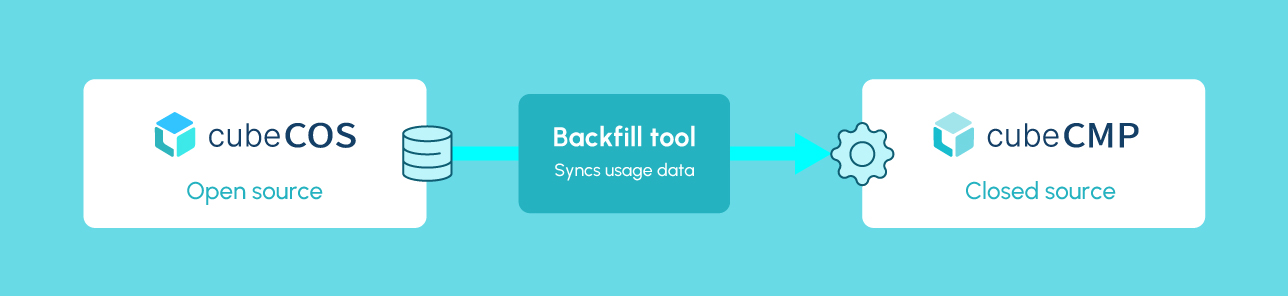 Image: CubeCMP 2.1 includes a backfill tool that registers existing OpenStack tenants on CubeCOS
Protect your infrastructure investment with open standards
With its seamless migration from the platform's existing RKE1 support, CubeCMP 2.1's adoption of the RKE2 Kubernetes distribution allows operators to choose their Kubernetes distribution without changing management workflows. Cluster node pools can be placed on specific private networks and protected by an NFV-aware firewall policy, thereby extending CubeCMP's network virtualisation model to containerised workloads.
Key improvements in CubeCMP 2.1
Secure Kubernetes platform and workloads on RKE2 with integrated NFV
This release adds full support for RKE2 clusters alongside the platform's existing RKE1 support, giving operators a choice of Kubernetes distribution without changing their management workflow. Cluster node pools can be placed on specific private networks and protected by NFV-aware firewall policy, extending the platform's network virtualization model into containerized workloads. Read more→
Resource cost visibility is built in, not bolted on
Site admins and project owners now have native consumption trend charts, cost rankings, and time-scoped breakdowns inside the portal. No external FinOps tooling needed for baseline cloud spend visibility across projects and providers. Read more→
Multi-network workloads are a first-class citizen
Virtual machines (VMs) and Kubernetes cluster workloads can now connect to private networks more easily, with support for more flexible firewall configurations, floating IP reservations, and network segmentation. This forms the foundation for NFV and carrier-grade deployments on open infrastructure.
Reliability fixes in this release
Audit trail accuracy
Previously, event records dropped user identity and source IP address information for certain operations, such as firewall changes, volume clones, and administrative actions. Now, all audit events carry the correct user and IP, and the History view shows the accurate operation duration, which is critical for compliance reporting.
Tenant network lists no longer crash on legacy projects.
Site administrators managing environments with older project records experienced portal crashes when listing private networks. This issue has been resolved, ensuring that mixed-vintage deployments are safe to operate from a single admin view.
Auto-scaling group password injection now works on both Linux and Windows.
ASG instances were failing to receive CloudInit credentials on Windows, resulting in silent provisioning failures. The fix ensures that passwords are injected correctly, regardless of the guest operating system, thereby reducing ghost VM incidents in auto-scaled fleets.
Scale Your Hybrid Cloud with Confidence
CubeCMP 2.1 provides organizations with greater control over modern cloud infrastructure by combining native NFV, multi-network workload support, integrated cost visibility, and policy-driven security. Whether you're expanding an existing OpenStack environment, evaluating alternatives to proprietary virtualization platforms like VMware NSX, or building a hybrid cloud strategy from scratch, CubeCMP 2.1 reduces operational complexity while preserving the flexibility, security, and vendor independence of open infrastructure.
Ready to see CubeCMP 2.1 in action?

Find out how CubeCMP can help your organization modernize its hybrid cloud operations and maintain complete control of its infrastructure.
Frequently Asked Questions
What's new in CubeCMP 2.1?
CubeCMP 2.1 adds native Network Function Virtualization (NFV), full multi-network topology support, a rebuilt policy-driven firewall, RKE2 Kubernetes support, deeper resource cost analysis, a fully localized portal, and a backfill tool for non-disruptive onboarding of existing OpenStack tenants.
Is CubeCMP a VMware NSX alternative?
CubeCMP 2.1 is positioned as an alternative to VMware NSX for organizations running OpenStack-based infrastructure via CubeCOS, delivering multi-network segmentation, a software-defined firewall, and floating IP management built on open infrastructure standards rather than a closed virtualization stack like vSphere.
Does CubeCMP support RKE2 Kubernetes?
RKE2 is fully supported by CubeCMP 2.1 control plane, and the migration from RKE1 happens automatically during cluster upgrade. Cluster node pools can now be placed on private networks and protected by the new bi-directional firewall engine.
Does implementing CubeCMP require re-provisioning of existing OpenStack workloads?
The backfill tool registers existing OpenStack tenant workloads with the CubeCMP data model, eliminating the need for re-provisioning or disruption of running workloads.
How does CubeCMP's firewall work in 2.1?
CubeCMP 2.1 includes a rebuilt, policy-driven, software-defined firewall. It enforces automatic CIDR isolation policies and supports tenant- and project-level network isolation across VMs, containers, auto-scaling groups, and load balancers.
Does CubeCMP provide cloud cost visibility without third-party FinOps tools?
CubeCMP 2.1 provides site admins and project administrators with native cloud- and project-level resource analysis, including consumption trends by resource category, cost ranking by tenant and resource type, and time-scoped revenue and cost breakdowns. All of this information is available within the platform.

/Events%20and%20News/Play-List.jpg)
/Events%20and%20News/CubeCMP-2.0-Release.jpg)